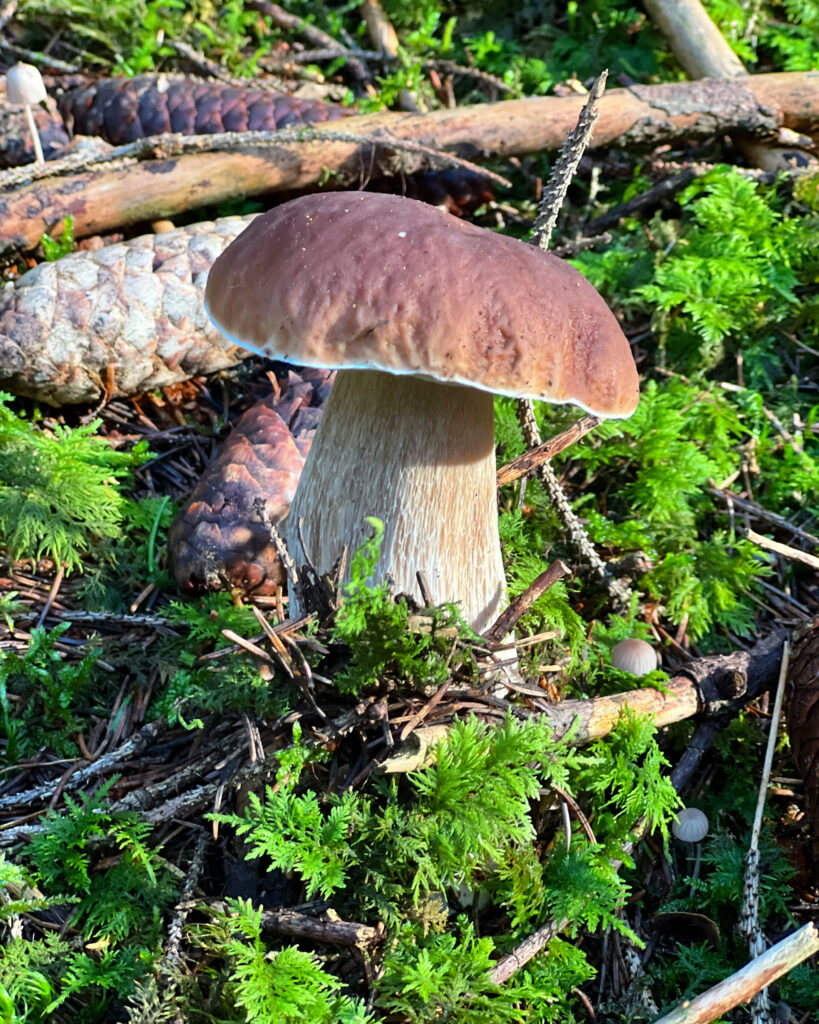
With the arrival of summer rain and warm days, Czech forests are once again turning into a paradise for mushroom hunters. Seasonal species are popping up—especially the highly prized porcini mushrooms (Boletus edulis), a true trophy in any basket. But mushroom picking in the Czech Republic isn’t just a pastime—it’s a deeply rooted tradition, passed down through generations and intimately tied to our connection with nature.
Such is the Czech passion for mushrooming that the Czech Hydrometeorological Institute even issues a specialmushroom forecast, showing where mushrooms are currently thriving!
Another unique aspect of mushrooming in the Czech Republic is its legal openness. Unlike in many countries, you’re free to walk into nearly any forest and pick mushrooms for personal use—regardless of who owns the land. As long as the area isn’t fenced off, undergoing logging, or a restricted zone (like military property), you’re welcome to enter on foot. Driving into the forest is prohibited, but walking in is part of the tradition. Just grab your basket and go.
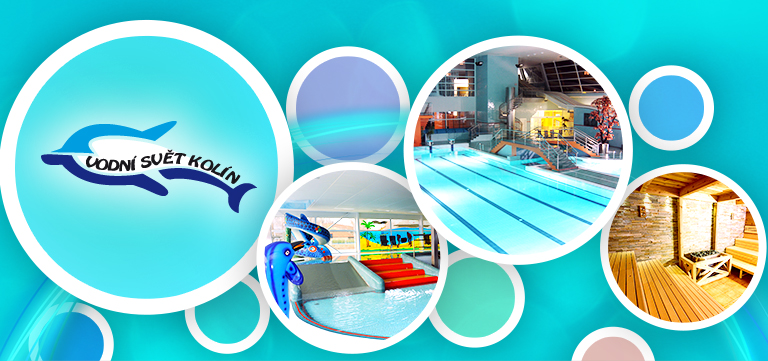
Water World Kolín offers a wide range of sports, entertainment, relaxation and services. There is an outdoor and indoor area, a sports field, relaxation services in the water and on land + a richly equipped aquapark. It includes a large free parking lot and a popular restaurant.
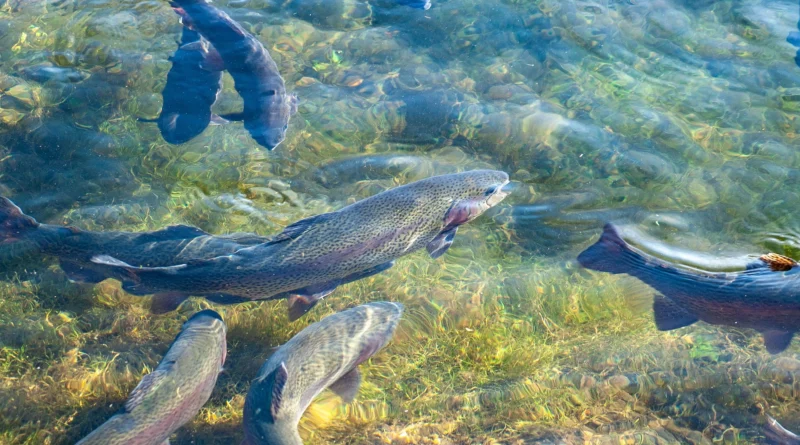
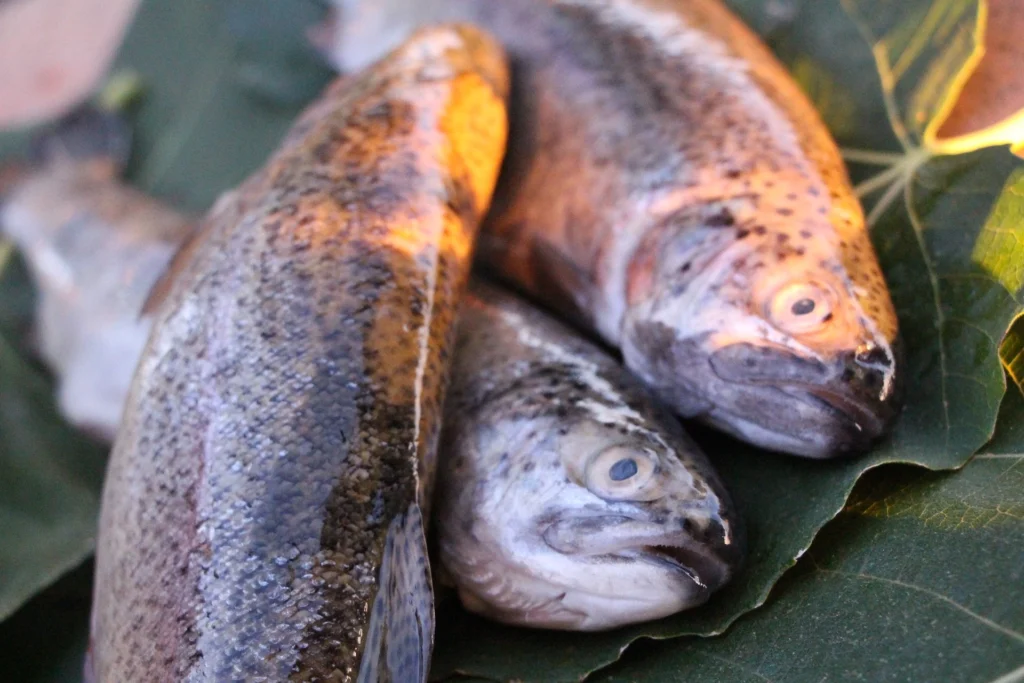
A great way to spend your free time and try a new activity under pleasant conditions. Catch your own trout and enjoy it later while watching the sunset and grilling…
The pond is located in the grounds of the nature camp
Not far from Zbraslavice Airfield lies a mysterious place where flying Sharks come into the world. This is the technology park of HpH Ltd, equipped with state-of-the-art facilities.
HpH Ltd is a company with a long tradition in the aviation industry. Thanks to its participation in the initial design of Diamond aircraft (Dimona, Katana) and most recently the excellent EB29, HpH has earned a reputation for exceptional build quality and attention to detail.
In 1997, HpH managed to acquire the technology and production documentation for the original Glasflügel 304. Production began in 1997 with the updated Glasflügel 304, the HpH 304CZ, which proved itself both with customers and in competitions. HpH later filled a gap in the market by producing the HpH 304C Wasp, a budget version of the 304CZ for the FAI Standard Class. Both models are highly praised in the gliding community.
If there is a non-flying day on Friday, July 25th, 2025 from 13:00, or on Saturday, July 26th, 2025 from 13:00 (before the opening ceremony), tours of the HpH facility will be available.
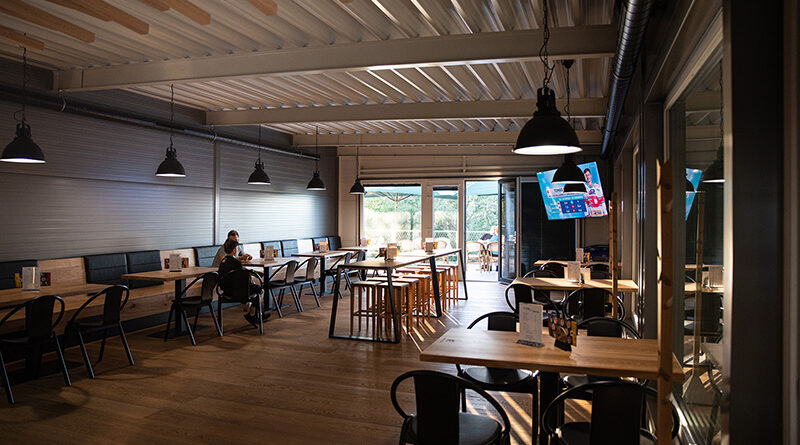
For WWGC2025 participants, Jaroslav Potměšil (Founder and CEO of HPH Sailplanes) has brought a large box of lavender, which will freshen up your tents and caravans. It is available to everyone in the larger part of the restaurant, right by the entrance.
The Švihov (Želivka) Waterworks – the Largest Drinking Water Reservoir in the Czech Republic
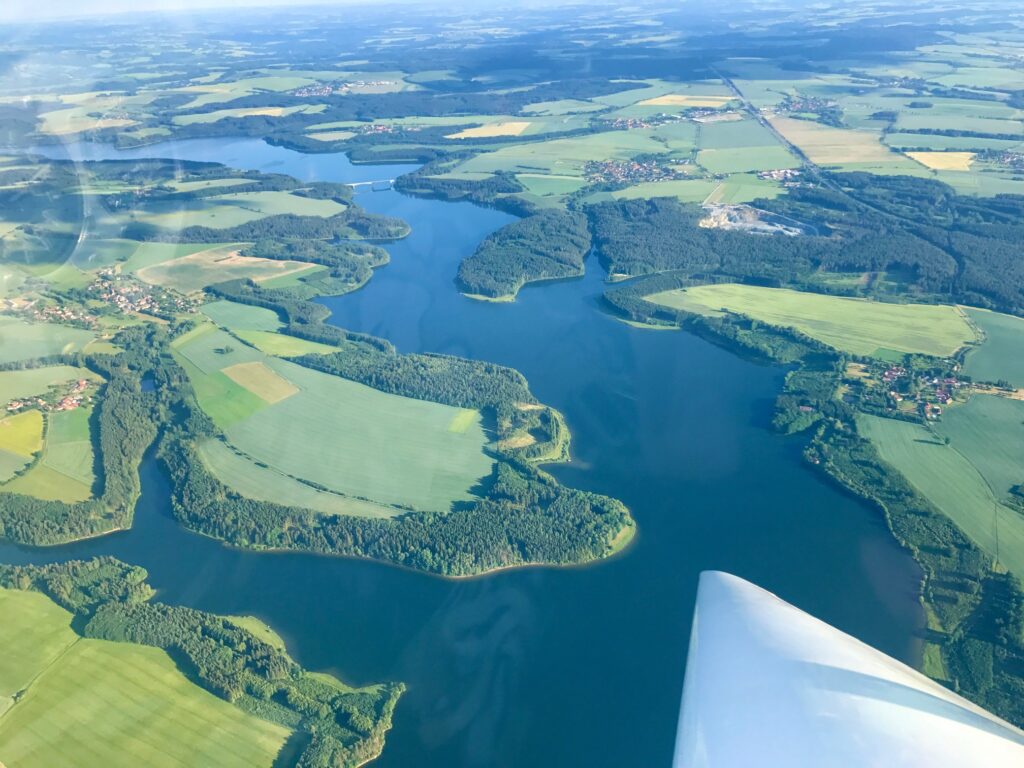
The Švihov reservoir (more commonly known as the Želivka reservoir) is a water reservoir on the Želivka river, serving as the main source of drinking water for the Central Bohemian region, including Prague. It is not only the largest water reservoir in the Czech Republic but also in Central Europe.
The dam was constructed between 1965 and 1975 at river kilometer 4.29, above the confluence of the Želivka and Sázava rivers. The straight earth-fill dam reaches a height of 58 meters and is 860 meters long at the crest. Upstream of Švihov, a system of smaller reservoirs (Trnávka, Němčice, Sedlice) was built to capture sediment before it reaches the main drinking water reservoir.
The reservoir supplies drinking water primarily to Central Bohemia and Prague, but also to the regions of Humpolec, Pelhřimov, Pacov, Ledeč nad Sázavou, and Havlíčkův Brod. Covering an area of 1,602.6 hectares and holding 309 million cubic meters of water, it is the largest reservoir of its kind in the Czech Republic and Central Europe. The dam lake stretches 38 km, and the dam is 58 m high and 850 m long at the crest. The water treatment plant has a capacity of 7,000 liters per second. A road bridge on road no. 18, between Bezděkov and Brzotice, crosses the reservoir.
A major challenge for engineers was transporting the water to Prague. After several disputes, the plan for a pressurized tunnel pipeline won. The tunnel is more than 50 km long, starting at the water treatment plant in Nesměřice near the dam and ending near Jesenice by Prague, passing under the Sázava and Blanice rivers. The construction of this massive project dramatically affected local residents and the landscape. Several historic towns (Dolní and Horní Kralovice, Zahrádka, and several small villages including Švihov) disappeared from the map; nearly 900 buildings were demolished, including a chateau, church, and railway station.
Although the area around the Želivka River was once the most visited part of Vysočina, access to the reservoir is now strictly prohibited – no entry, no fishing, no swimming. However, it is possible to book a guided tour of the dam at the Water House.
About the Water House
The Water House provides entertaining and educational information about the importance of water for both nature and humans, focusing on the Želivka area of European significance and the Švihov reservoir. The indoor exhibition takes visitors through five main sections. The atrium of the Water House invites you to play and explore.
Everything about water under one roof. The modern exhibition presents every aspect of water, from aquatic life to water in clouds, and even refreshing water activities. In the aquariums, fish swim lazily, while giant mussels offer a place to rest on pillows. You can try making a cloud and watch it float, maybe all the way to the water bar. Microscopes and enlarged models reveal the micro-world beneath the water’s surface, and the natural scenery comes alive with the sounds of birds and frogs. Learn all about drinking water and its cycle in the “Endless Journey of Water” section. A trip to history will take you back to the time of Charles IV, with original murals from the now-vanished church in Dolní Kralovice. Children will enjoy the water playground in the atrium. Information panels along the educational trail near the Water House explain the role of water in the landscape. We offer educational programs for all ages, from kindergarten to high school. You can also book a guided tour of the Švihov reservoir.
OPERATOR
The Water House was built and is operated by the Czech Union for Nature Conservation Vlašim. It is a civic association whose mission is to protect and care for the natural and cultural heritage of the Podblanicko region. In the center of Vlašim, it runs the Podblanické Eco-centre, which offers school programs, courses, and public lectures. It also operates the ParaZOO, an exhibition of animals that, due to injuries, cannot be returned to the wild. Injured animals receive medical care at the Rescue Station in Pavlovice near Vlašim. The association also helps municipalities and individuals care for non-forest greenery.
TOUR OF THE DAM
During the summer holidays, you can look forward to popular guided tours of the Želivka dam, organized by the Water House in cooperation with the Vltava River Authority.
Tours in July are held Tuesday to Friday at:
🕤 9:30
🕥 10:30
Rules for Participants
Meeting point is always at the Water House reception.
The minimum number of participants is 10 people. Individuals may join existing groups.
If you are an organized group, please book your tour in advance at vodnidum@csop.cz or by phone at +420 602 665 409.
Each participant must provide their name, surname, date of birth, and address on the attendance sheet. Personal data is processed in accordance with the Personal Data Protection Policy of Povodí Vltavy, s. p. (If you are a group, the attendance sheet will be sent by email and should be handed in at reception before the tour.)
No luggage or bags (not even hand luggage) can be taken on the dam; you may use lockers at the Water House.
Photography is allowed.
During the tour, participants must remain on the road at the top of the dam. Entry into the body of the dam or onto access bridges is not allowed.
The tour lasts approximately 45–60 minutes. The price for a guided tour is 120 CZK per person.
Healing Spring and the Church of St. Anna in Sudějov
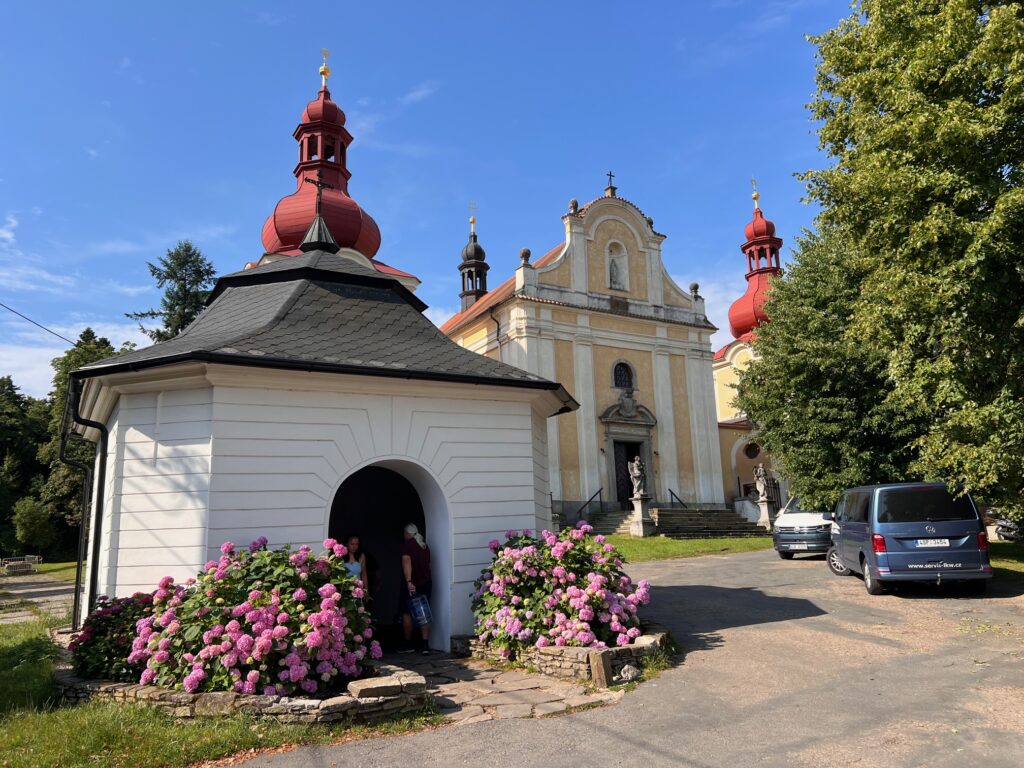
While the Švihov reservoir provides water mainly to Prague residents, for locals, a different water source is important. Every WWGC participant can visit and collect water from the healing spring in Sudějov.
The history of the local church and village is closely linked to the spring, whose water is said to have miraculous healing properties. The spring, known as Sudějovka (possibly from the Czech word for “to judge” due to historical property disputes over the area), has been famous for its healing water since the Thirty Years’ War. Pilgrims have come here not only from Bohemia, but also from Moravia and even Hungary. In the late 17th century, a wooden chapel of St. Anna was built by the Jesuits who owned nearby Žandov. In 1724, the present Baroque pilgrimage church replaced the chapel, commissioned by Count Karel Jáchym Breda. Its grand consecration took place on St. James’s Day, July 25, 1725, and the main pilgrimage was held the next day on St. Anna’s Day—a tradition that continues every year on the Sunday after St. Anna’s Day. Ambits (covered walkways) with three chapels and side belfries were added and completed in 1742, but later deteriorated and were demolished in 1819 due to lack of funds. In 1843, a small chapel was built above the spring in front of the church, which stands to this day. The current appearance of the chapel with the spring dates from 1934–1946 and is located just in front of the church’s left tower.
The church and its interior were repaired several times in the 19th and early 20th centuries. However, during the communist era, the church fell into disrepair and was robbed in the 1990s, losing valuable statues and decorations. Since 1998, the village has undertaken a general restoration of the whole site, starting with stabilizing the church structure to prevent collapse. These demanding repairs have been possible thanks to support from the Czech Ministry of Culture. Both the exterior and interior are being restored.
The water from the spring has certainly not lost its magical power and is available to everyone 24/7. Queues often form at the spring as people from the surrounding area come to collect it. The untreated water really does taste different! Bring your own bottles and come try it for yourself.